|
The measurement of isotopes ratios, such as 13C/12C, is important in chemistry and other fields, such as geology, since it provides useful information on formation and transport processes. The most common method used to measure isotope ratios is the isotope ratio mass spectrometer (IRMS), which is bulky, requires user expertise, and is costly. The measurement of isotope ratios can also be done through absorption spectroscopy using cavity ring-down spectroscopy (CRDS).1
We have developed an instrument capable of measuring carbon isotope ratios in organic samples (Figure 1A). The sample is injected into a gas chromatograph (GC) where it is separated into its components. The effluent is passed through a catalytic combustor (C) consisting of platinum and oxidized nickel wires in a ceramic tube heated to 1150 ºC, which completely oxidizes the carbon in the sample to carbon dioxide. The combustion products are fed into a CRDS instrument to measure the concentrations of 12C16O16O and 13C16O16O. We refer to our setup as GC-C-CRDS.
A mixture of methane, ethane, and propane injected in our instrument can be separated, oxidized, and measured as shown in Figure 1B. The chromatographic peaks are used to determine the ratio of 13C/12C in the sample. The current instrument can measure isotope ratios with a precision of less than one part per thousand and an accuracy of less than a few parts per thousand. Our instrument does not currently match the capabilities of instruments based on IRMS, but we expect future improvements to make our instrument an attractive alternative to IRMS. Despite the present limitations, the performance is sufficient for certain applications such as those in the oil industry. We plan to test our instrument by measuring isotope ratios of hydrocarbon gasses produced from petroleum sources which can provide useful information during the characterization of an oil reservoir.
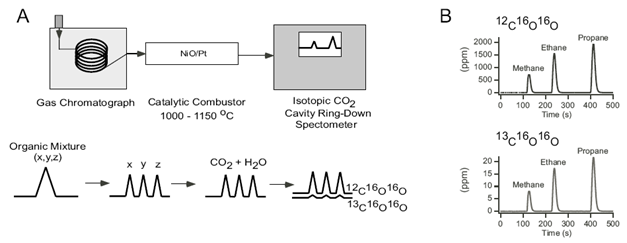
Figure 1. (A) The GC-C-CRDS instrument. The sample is separated using gas chromatography and combusted to produce carbon dioxide and then the isotopic carbon dioxide concentrations are measured using cavity ring-down spectroscopy. (B) Chromatograms of 12C16O16O and 13C16O16O produced from a mixture of methane, ethane, and propane.
1 R. N. Zare, D. S. Kuramoto, C. Haase, S. M. Tan, E. R. Crosson, and N. M. R. Saad, Proc. Natl. Acad. Sci. (US) 106, 10928-10932 (2009).