| |
Collaborations
Blake Meyers' Lab at University of Delaware
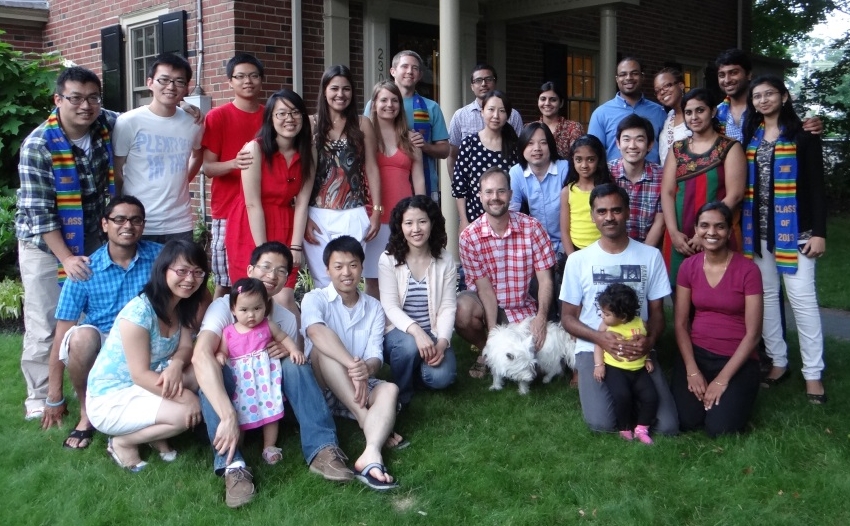
New NSF Project starting soon with Blake Meyers' lab at the University of Delaware. Here they are frolicking outdoors -- with children and pets!
Kids and dogs are not working in the lab, but everyone else is!
We really enjoy our collaboration involving analysis of small RNAs, phasiRNAs, and gene expression in pre-meiotic maize anthers.
Jixian Zhai and Blake Meyers, modeling the Walbot lab 2013 field hats! Welcome to the world of corn.
For non-scientists, the hat depicts the wild ride of a research ear of corn, husks raised into the air
to heighten the thrill, on the roller coaster of a DNA double helix. WHEEEEEE!!

Cal Poly San Luis Obispo
We maintain our annual summer project at Cal Poly SLO, now in its sixth year in
2010. This involves 3 or 4 undergraduates each summer in our field
screen for new Mu-tagged mutants of key genes in anther
development. See the Methods section for a handbook describing this summer research
experience.
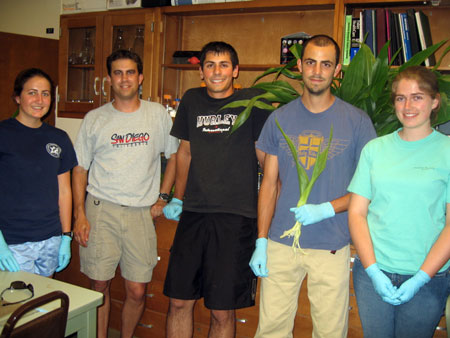
Dave Skibbe of Stanford (second from left) smiles for the
camera, reflecting the excellent help he received from Sarah (far
left), Eric, Cedric, and Kristen in dissecting tens of thousands of
staged anthers from Mutator tassels. Multiple replicate samples of each
stage from four pairs of sister active and inactive Mutator lines are
being used in proteomics and transcriptome profiling to pinpoint gene
expression changes during anther development and to discover proteins
whose abundance or post-translational status is affected by Mutator
activity.

Our 2005 Stanford field hat commemorates the drive to Cal
Poly -- 3 hours on Highway 101 -- well worth every minute to work with
our collaborators at SLO.
Anther Cell Fate Setting
Projects:
Cell
Fate Acquisition Project
Table 1. Cytological analysis, allelism results
Table 2. Transcriptome profiling, BSA mapping, Mu tagging, cloning progress
Table 3. Double mutant analysis
Table 1. Cytological analysis, allelism results
|
Locus
|
#
|
Alleles we found
|
Cloned
|
Transverse cytology
|
Confocal cytology
|
|
am1
|
1
|
|
yes
|
Meiotic
entry failure am1-praI
l/z failure
|
|
|
msca1
|
2
|
EMS63131
= ms*6064
= 3 alleles Multiple Mu
tagged alleles were all deletions
|
yes
|
Leaf
cell types in anther;
excess cell layers; no archesporial cells
|
Yes
|
|
mac1
|
3
|
mac1-MuDR
= 2
alleles
|
yes
|
Excess
PMC
|
Yes;
early defect in
archesporial proliferation rate
|
|
ocl4
|
4
|
mtm99-66
= 2
alleles
|
yes
|
Extra
subepidermal anther
layer ?? from epidermis??
|
|
|
ms7
|
|
Used in allelism testing
|
|
|
|
|
ms8
|
5
|
mtm99-56
= 2
alleles
|
yes
|
PMC
failure; too few tapetal
cells
|
Epidermal
cells fail to
elongate; too few tapetal cells; excess callose
|
|
ms9
|
6
|
Multiple
Coop allleles
|
yes
|
Irregular
tapetal layer;
partial double middle layer.
|
ML
& T more active
cell division than normal but
Ratio of ML/T is normal
|
|
ms10
|
|
Late
mutant Used in allelism testing
|
|
Late
uninucleate failure
Dong Xue has extensive cytology
|
|
|
ms11
|
|
Late
mutant Used in allelism testing
|
|
Tapetal
failure
|
|
|
ms13
|
7
|
Multiple
Coop alleles
|
|
Additional
anti and
periclinal tapetal divisions; all tapetal cells are binucleate
|
Extra
divisions confirmed
Cell walls don’t look good – Maybe a wall defect?
|
|
ms14
|
8
|
Multiple
Coop alleles
|
|
Small
meiocytes disappear
|
|
|
ms17
|
|
Late
mutant Used in allelism testing
|
|
Irregular
first and second
meiotic divisions; no defects in anther wall detected
|
Check
by confocal?
|
|
ms23
|
9
|
Placed
on chromosomes 6 and
8?; Coop and Mu
tagged alleles
|
|
Extra
periclinal division in
tapetal cells
|
Yes
Cell division defect at
900 µm
|
|
ms25
|
|
3
Mu-tagged
alleles Late Used
in allelism testing
|
|
Post-meiotic
Vacuolate
tapetal cells; microspores die
|
|
|
ms26
|
|
Used in allelism testing
|
|
|
|
|
ms32
|
10
|
Same
as ms60662
Now cloned
|
yes
|
Extra
periclinal division in
tapetal cells
|
Cell
division defect at
~1200 µm
|
|
tcl1
|
11
|
11
Mu-tagged
alleles plus EMS72063
is the
same
|
|
deranged
middle and tapetal
cell divisions
|
|
|
ms45
|
|
msN2499
=
EMS64409
Used
in some allelism testing
Late mutant = 3
alleles
|
|
Different descriptions
for these alleles
|
|
|
ms775
= csmd1
|
12
|
Mu
tagged alleles; mapping down to just a few genes
by Dongxue
|
close
|
Dongxue
Excess callose
pre-meiotically; uninucleate failure & vascular tissue
senescence coincide
|
|
|
mtm00-06
|
13
|
|
|
Very
small anthers
|
|
|
RescueMu
A60-35A
|
14
|
|
|
Collapse
of tapetal cells
before meiosis
|
|
|
EMS63089
|
15
|
Tagging
populations built
for 2012
|
|
Multiple
defects in wall
layers – parenchyma like
|
|
|
ms-si*-355
|
16
|
3
putons with Mu
tags recovered in summer 2011
|
|
No
anthers at 2 mm
|
|
|
ms*-6015
|
17
|
Placed
by the Schnable lab
for us
|
|
Multiple
number of cells in
tapetal layer
|
Very
thin ML; multiple
tapetal layers SPL div are asymmetric Tapetal cells smaller initially
but catch up
|
|
RescueMu
C17-32
|
18
|
|
|
Callose
deficiency around
meiocytes? Meiocytes lose their borders and degrade
|
|
|
RescueMu
E03-23
|
19
|
|
|
Irregular
middle and tapetal
layers. Multinucleate tapetum
|
|
|
RescueMu
A60-22b
|
20
|
|
|
Tapetum
layer separates from
other layers
|
|
|
EMS72032
|
21
|
Allelic to 71924
= 2 alleles
|
|
Two
lobed anther structure.
All layers present in the abaxial lobes; Meiosis is not affected
|
|
|
EMS71990
|
22
|
To
be crossed with ms-si*355
|
|
Few
spikelets on the tassel,
? with no anthers. Stronger phenotype than si*-355
|
|
|
EMS72091
|
23
|
|
|
Deranged
middle and tapetal
cell divisions and vacuolization
|
|
|
|
|
Late
Mutants
|
=
|
Lower
Priority
|
|
|
EMS63265
|
|
looks
similar to EMS71777
|
|
Defective
at late stage
(3mm): few hypersized multi-nucleate tapetal cells
lose their contact with the
tapetal layer
|
|
|
EMS71777
|
|
looks
similar to EMS63265
|
|
Same
description as above
|
|
|
EMS71787
|
|
|
|
Vacuolization
of middle and
tapetal layers at tetrad stage; premature tapetal cell degradation
|
|
|
|
|
Not
defective
|
after all
|
|
|
|
EMS72098
|
|
|
|
No
anther defects detected
– maybe special field conditions?
|
|
Key
genetic results: 23 loci with pre-meiotic defects. Six are cloned.
Mapping in progress for csmd1,
ms13, ms*6015, tcl1, ms23
Allelism testing ~90% done we have two
3 allele cases, and seven
2 allele cases, and 14
“unique” loci
(3 of these have multiple alleles from the Coop).
Table 2.
Transcriptome profiling, BSA mapping, Mu tagging, cloning progress
|
Locus
|
Mapped?
|
Cloning
progress
|
Transcriptome
|
Mu-tagged
or other alleles
|
Published?
|
|
am1
|
Done
|
Pioneer
protein
|
Gillian: am1-489 & am1-praI
|
N/A
|
Cande
lab PNAS Gillian
poster and ms. in progress
|
|
msca1
= ms22 on chr7
|
Done
|
glutaredoxin
|
Leaf
cell types in anther
|
|
Pioneer
patent
application 20090038028
|
|
mac1
|
Done
|
tpd1-like
?secreted
|
22K
array and 44K PMC
& early stages by Tim
|
N/A
|
Rachel
writing ms. Long
overdue.
|
|
ocl4
|
Done
|
HD zipIV
transcription
factor
|
|
|
Vernoud
2009 Plant J
59: 883-894.
|
|
ms7
|
Used in allelism testing
|
|
|
|
|
|
ms8
|
Dave – cloned
Sept 2010
|
1,3 beta galactosyl
transferase
best match
|
1.0
1.5 2.0 mm
precocious
expression of 40% genes; many changes
|
Historic
and 8 Mu-tagged
alleles
|
Dong
Xue pub 2010 Plant
J
Strasser lab
in Vienna
unlikely match to Lewis epitope gal transferase
|
|
ms9
|
|
|
|
Historic
Mu
tag 1,350
pilot
screen
2011;
more
2012
|
|
|
ms10
|
Dongxue
chr10L bin04
|
|
|
Historic
2 Mu putons
2010
|
Definitely
not
allelic
to csmd1
|
|
ms11
|
Late
|
|
|
1 Mu
puton
2010 Mu
tag
|
|
|
ms13
|
Ch5
|
|
|
Mu
tag to
screen
2011
|
|
|
ms14
|
|
|
|
Failed
to tag in large 2010 population
|
|
|
ms17
|
Late
|
|
|
|
|
|
ms23
|
Dave 8S
small interval
|
|
OId
22K for 1, 1.5, 2.0 mm
Lan
summer 2010
1.5 mm
|
Multiple
Mu
and historic
|
|
|
ms25
|
Late
|
|
|
3 Mu
tag plus
historic
|
|
|
ms26
|
Used in allelism testing
|
|
|
historic
|
|
|
ms32
|
Dave 2L
Sm
interval
Jihyun
cloned
Feb 2011
|
bHLH factor
|
Lan
summer 2010 1.0
&
1.5 mm array
|
2 Mu
tag plus
historic
|
Write
up cloning,
expression,
arrays
&
confocal
??
|
|
ms45
|
Done
|
Possible strictosidin synthase
|
|
5,478,369
patent
number
|
Sexual
Plant Reproduction
14, 135-142
Pioneer
|
|
ms775
=
csmd1
|
Dong
Xue small interval
chr10L bin04
|
|
|
2 Mu tag
Mu
tag to
screen 2012
|
Dongxue
2011 Sex. Plant
Reprod.
|
|
mtm00-06
|
|
|
|
Mu
tag 19,200
screen
2011
|
|
|
RescueMu
A60-35A
|
|
|
|
|
|
|
EMS63089
|
Karl, Sidae
|
|
|
Mu
tag to
Set
up 2011
|
|
|
ms-si*-355
|
Newly
tagged
|
|
|
Mu
tag 10,500
screen
2011
|
|
|
tcl1
|
Tim 3L
BSA –location confirmed by Gillian via Schnable lab
|
|
|
2011
alleism
scoring
testing
mac1-Mu
likely
to
be tcl1-mu
|
|
|
ms*-6015
|
|
|
|
Mu
tag 7300
seed
screen
2011
|
|
|
RescueMu
C17-32
|
|
|
|
|
|
|
RescueMu
E03-23
|
|
|
|
|
|
|
RescueMu
A60-22b
|
|
|
|
|
|
|
EMS72063
|
|
|
|
|
|
|
EMS72032
|
Karl,
Sidae
|
|
|
EMS71924 is
allelic
|
|
|
EMS71990
|
|
|
|
|
|
|
EMS72091
|
|
|
|
|
|
|
Lower
priority late mutants
|
|
EMS71777
|
Late
|
|
|
|
|
|
EMS71787
|
Late
|
|
|
|
|
|
EMS63265
|
Late
|
|
|
|
|
|
EMS72098
|
Drop
it
|
|
|
|
|
Set-up
for screening in summer 2011 at Webb Ranch 1.5 acres
ms*6015
microscopy makes a strong case for this locus = 7300 seed No putons
ms si*355
10,500 3 putons
mtm00-06
19,200 No putons
ms9
1,350 pilot population No putons
Generate tagging
populations in summer 2011 at Stanford University for 2012 screen on 4
acres at Webb Ranch
ms9
(transverse & confocal imaging look very interesting) 20K seed
goal
ms*6015
another 13K seed goal
EMS63089
20K goal has been very hard to get seed
ms si*355
11K goal
ms14
20K goal (second attempt to get tagged alleles)
ms13
10K goal
Tagging populations
already available for 2012 when there is more field space
csmd1,
if cloned we can look for another allele if we want to 10,200 seed
ms10,
outside our developmental window 10,000 seed lower priority
ms13,
9,400 seed
ms17,
2,850 low priority
Table 3. Double
mutant analysis
The crosses used in allelism testing yield plants suitable for double
mutant construction.
msca1//msca1
male-sterile x mac1//Mac1 male-fertile
20 to 30 individuals are evaluated in the following season. If all are
fertile, two loci are defined as in this example. The individuals are
of two genotypes
Single
carriers Mac1//Mac1
Msca1//msca1
Double carriers Mac1//mac1
Msca1//msca1
Eight to ten fertile individuals are self-pollinated.
Single
carriers segregate 3:1 F:sterile Double carriers segregate 9:7 F:sterile
The two types of
families are distinguished in growouts of 60 or more individuals.
Within the 9:7 families, 1/7 of the plants are double mutants. If one
or both of the genes of interest has been cloned or fine-mapped, PCR
markers are used to genotype plants before the tassels develop to
identify the homozygous double mutants and each of the single mutants
for confocal or molecular analysis.
To check if we have
made the double mutant stock, do a search in GENETIC RECORDS from the
Walbot lab website (click on the tag on the left margin of the home
page). After the genetic records load, click on
“search” and put in both gene abbreviations and
click “and” to make it a both required search. This
search should take you to the cross that combined the two defective
alleles and the subsequent progeny, if analyzed.
|